£45.00
Isaac Oloche Johnson
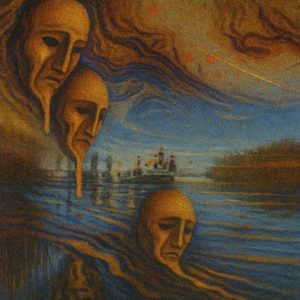
Tears of the Creek, 2025
Digital art print
60 x 14 cm
4 in stock
Description
Tears of the Creek by Issac Oloche Johnson is one of three artworks exhibited in GroundWork Gallery’s Fluid Earth Exhibition. Proceeds from the prints go to the Niger Delta Community which enabled Johnson to be able to make the artworks.
Tears of the Creek embodies the paradox: water, which usually cleanses tears, has now become the one that cries. A creek should flow, nourish, and connect, but here it weeps instead of flows. The tears belong not just to the landscape, but to the generations who drink, fish, and pray from these waters. By transmuting pollution into tears, the piece reframes destruction as lament, the land weeps because it still lives enough to feel.
The colour scheme creates a tension between vitality and mourning, much like the creek itself, alive, yet scarred. Yellow ochre is the tone of earth and memory. Dark brown suggests the burden of oil, the heaviness of suffocation. Blue represents the suppressed purity of water, now stained. Tiny red-orange flecks are the flares of violence, reminders of the fire outbreaks, gas flares, and disruption.
When Water Wears Masks focuses on the faces borne by water. Tears of the Creek emphasises the emotions carried by water. Together, they give the Niger Delta’s ecosystem not just a visage, but a voice: a body.
About the artist
Isaac Oloche Johnson describes himself as a code artisan. Offering a fresh technologically driven approach to engaging with environmental and social themes, Isaac Oloche Johnson has qualifications and experience both in applied psychology and computer science. He crafts immersive digital realms, blending tradition with technology. With a passion for African crafts and artistry, Isaac aims to redefine spatial understanding and enable innovative aesthetic approaches. As a recent Dreaming New Worlds Fellow at the Goethe Institute Nigeria, he explored the intersection of technology and artistry. His research project and interactive exhibition ‘We were here’ reimagined the act of excavation including cultural memory, identity and lost histories, to explore how extractivism affects physical and cultural landscapes. He is specially interested to pursue further projects in connection with Igbo African communities, inspired by traditional Igbo philosophies of nature and resource use Isaac aims to create a dynamic participatory digital archive that explores extractivism through Igbo cultural frameworks aiming to tell layered stories of land, loss and resilience.